PAGE 2
Bond Behavior between FRP Sheet and Concrete

| Reference : T. Kanakubo, Z. Wu, T. Ueda: Influence of Local Bond Characteristics in FRP-Concrete Bond Behavior, 11th International Conference on Fracture, Proceedings CD-ROM, No.4292, 2005. 3 T. Kanakubo, T. Furuta, H. FukuyamaF Bond Strength between Fiber-Reinforced Polymer Laminates and Concrete, Proceedings of 6th International Symposium on Fibre-Reinforced Polymer (FRP) Reinforcement for Concrete Structures, Vol.1, pp.133-142, 2003.7 Kasumassa Nakaba, Toshiyuki Kanakubo, Tomoki Furuta, Hiroyuki YoshizawaF Bond Behavior between Fiber-Reinforced Polymer Laminates and Concrete, ACI Structural Journal, Vol. 98, No. 3, pp. 359-367, May-June 2001 |
|
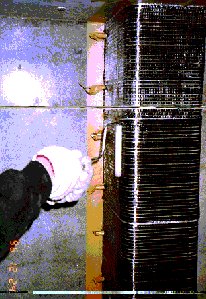
FRP sheet strengthening Two methods for strengthening or upgrading have been popular in Japan. One is the increasing of sectional area by post-casting concrete, and the other is the confining of members by steel plates. These methods, however, need many processes, much time, good techniques and heavy machines. Recently, strengthening method using continuous fiber, such as carbon, glass and aramid fiber have been focused because of its simplicity for construction site and economy. The simplest way to use fiber for strengthening is wrapping of members by sheets. Many investigations and studies concerning with fiber sheet strengthening are now going on both for building and civil engineering site in Japan. |

|
|
Bond between FRP sheet and concrete The anchorage between concrete and FRP sheet plays an important role in reinforcing design. As a brittle material, FRP show a lack of ductility, and the failure mode happens suddenly, without preceding yielding. Recently, many studies have been done to understand the bond behavior between concrete and FRP sheet, but at the present stage it is not advanced sufficiently to apply in projects of real structures. For these reasons, in terms of adhesion, it is necessary to confirm its safety, or seek for a bond length considering an adequate safe bond stress, in order not to allow the appearance and progress of bond rupture. In cases when the bond rupture or anchorage rupture form is unavoidable, it is necessary to obtain the rupture strength experimentally based on reliable data that consider an adequate safety. |
|
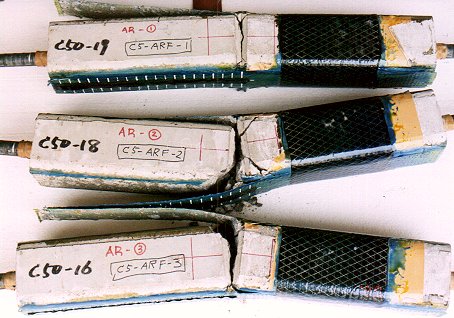
Test program The specimen consists of a concrete prism (100 x 100 x 600mm) cracked at the center, using a hammer on the notch, after the reinforcing with FRP sheet. The two steel bars also have no connection, which means that the two prisms are connected only through the FRP sheet. FRP system used in this research consists of fiber impregnated with epoxy resins, with primarily preparation of the concrete substrate using primer and putty. Putty is a thickened epoxy paste to fill voids and smooth surface discontinuities. FRP sheets are bonded at two opposite sides of the specimen. One of the sides of the specimen was reinforced with a confinement FRP allowing the occurrence of delamination of the sheet only on the opposite side, where the strain gauges were set. Once the tensile force from the FRP is transferred into the concrete, there are nearly no bond stress between the unbonded region. This means that when the bonded length exceeds a critical length (=effective bond length), the fracture load remains constant. |

|
|
Bond failure The specimens are submitted on tensile force until the total failure of the bond system took place. A layer of concrete is bonded on the FRP sheet after the failure. These facts are related with the interface between laminates and concrete, which is the region where the epoxy infiltrates into concrete, and where it is supposed to have a concentrated wearing between FRP and concrete. |